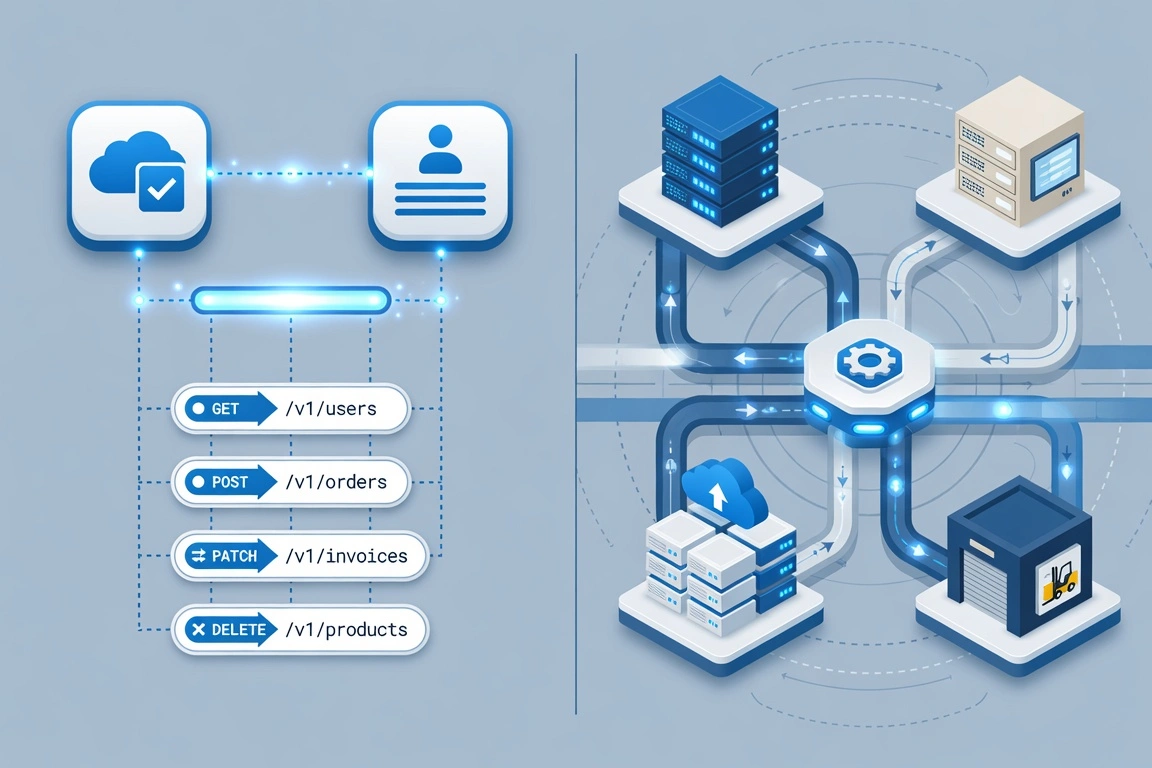
Key Takeaway. API integration connects specific apps through their published interfaces. System integration connects entire platforms — including legacy systems with no APIs. Most mid-size companies need both at different stages. Knowing which one fits your problem right now saves you six figures and several months of rework.
Table of Contents
- What Is the Difference Between API Integration and System Integration?
- When Should You Choose API Integration Services?
- When Does System Integration Make More Sense?
- How Do Costs and Timelines Actually Compare?
- Can You Use Both at the Same Time?
- What to Look for in an Integration Partner
- FAQ
Here's the scenario we see every week.
A company walks in with a familiar list: the CRM doesn't talk to the ERP, the inventory platform exports to a spreadsheet because there's no direct feed, and support staff manually copies order data between two systems that have never spoken to each other. Someone on the team googles "API integration." Someone else googles "system integration." They get quotes from three vendors. All three recommend something different.
Nobody agrees on scope, timeline, or cost.
The problem isn't the vendors. The problem is that API integration services and system integration services solve fundamentally different problems — and most companies are never told which one they actually need.
At Tizbi®, we've been building these connections for 28+ years. We've seen the over-engineered disasters and the brittle quick-fixes. Here's the honest breakdown.
What Is the Difference Between API Integration and System Integration?
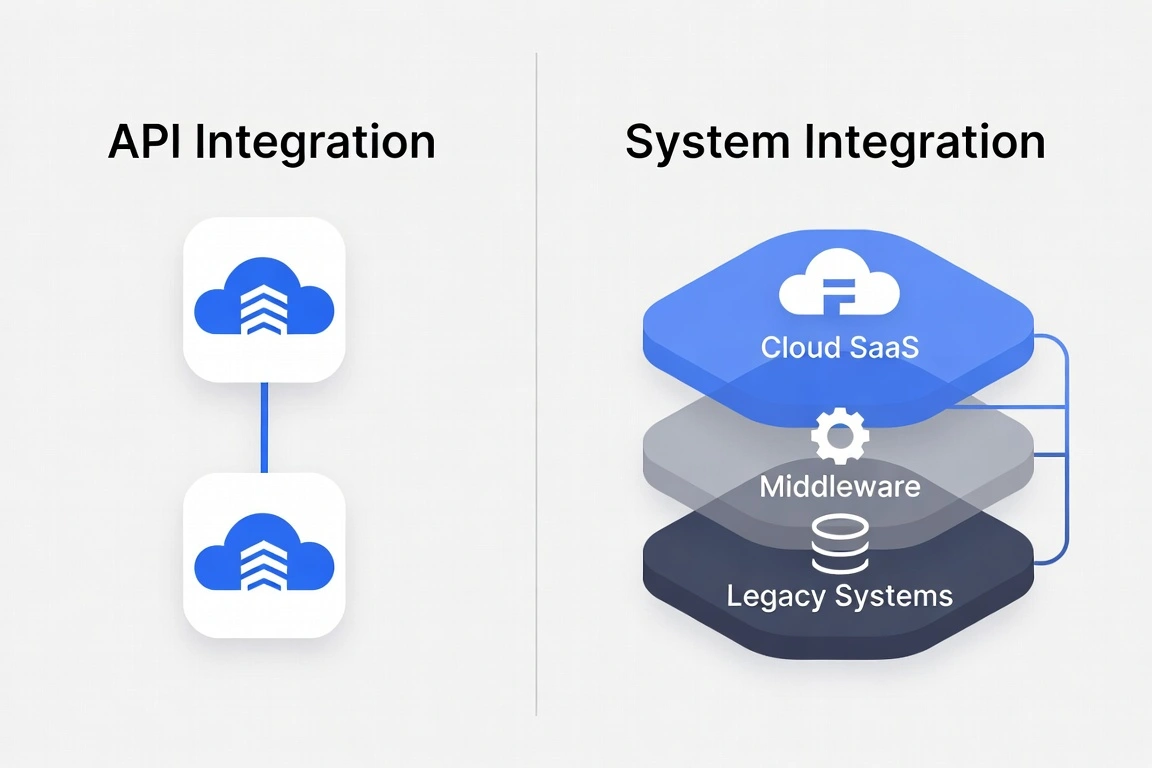
Think of API integration as a standardized electrical outlet. If both devices have the right plug — Salesforce, HubSpot, Stripe, QuickBooks — they connect cleanly. An API integration project wires those plugs together. Scoped. Documented. Relatively fast.
System integration is the whole electrical system in the building.
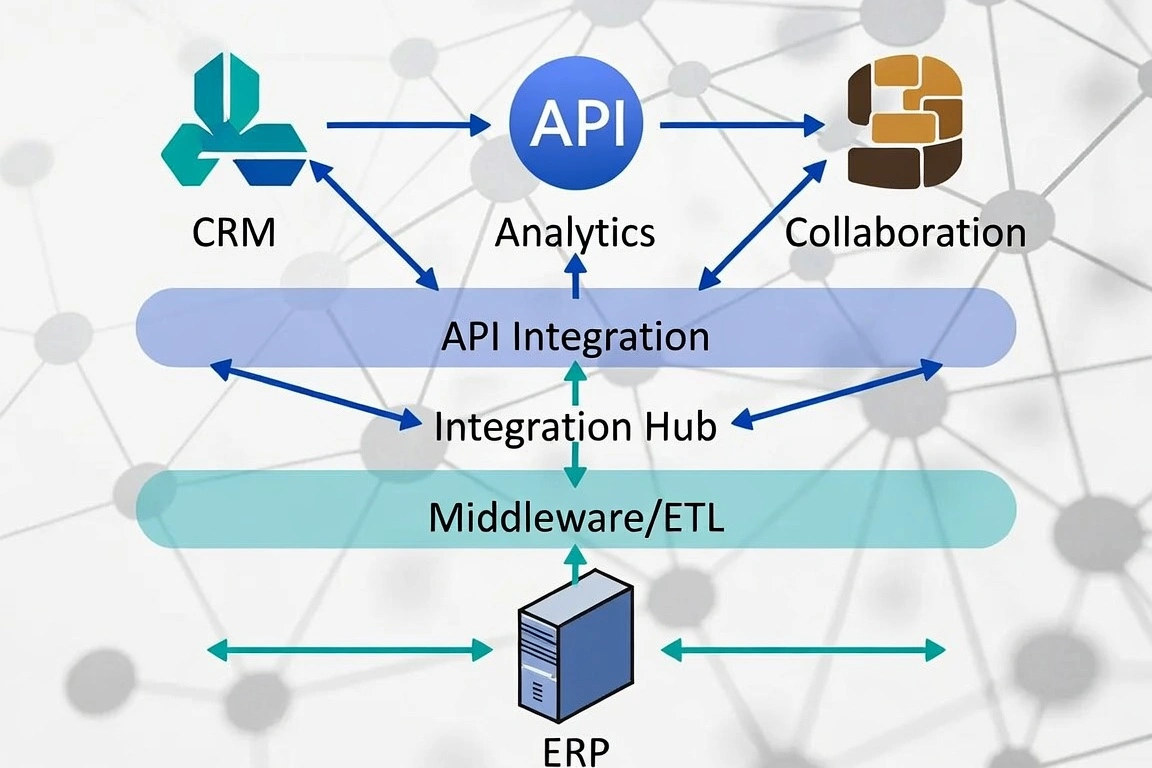
It connects platforms, legacy databases, infrastructure layers, and business processes — with or without an API. That ERP your company bought in 2008? Likely no public API. Your warehouse's barcode scanning software? Same. Your 3PL partner's portal? Maybe a partial one with inconsistent documentation. System integration uses middleware, ETL pipelines, file-based transfers, and direct database connections to move data through all of it.
The cleanest frame: every API integration is a form of system integration, but not every system integration uses APIs.
Practical example. Say you run a mid-size manufacturing company:
- Shopify → QuickBooks: API integration. Both have APIs, scope is clear, done in weeks.
- Shopify → 15-year-old on-premise inventory system with no API + warehouse barcode software + 3PL portal: system integration. Multiple layers, custom middleware, data transformation, orchestration logic.
According to MuleSoft's Connectivity Benchmark Report, IT teams spend nearly 30% of their time on integration work — and that number keeps climbing as software stacks expand.
When Should You Choose API Integration Services?
When both sides of the connection have well-documented APIs, don't over-complicate it.
Modern SaaS platforms are built to be connected. Salesforce, HubSpot, Slack, Stripe, Zendesk, ServiceNow — they publish APIs precisely so third-party software can plug in. If your goal is a specific, bounded connection ("sync new CRM leads into our email platform" or "push completed orders to our fulfillment vendor"), that's a well-defined API integration project. Clear start. Clear end. Clear deliverable.
API integrations move faster too. A well-scoped project goes live in weeks, not quarters — and that matters when a manual process is eating someone's full workday.
Tizbi®'s API Integration Services are built for these scenarios: clean, maintainable connections your team can understand and your engineers can extend. No unnecessary middleware. No overbuilt orchestration layer for a problem that doesn't need it.
When Does System Integration Make More Sense?
When legacy infrastructure, multi-system orchestration, or mission-critical data integrity enters the picture.
Legacy systems without APIs are more common than most people expect. If your ERP was implemented before 2015, there's a real chance it has no public API — or a partial, undocumented one that changes without warning. You can't API-integrate your way into a system that doesn't expose one.
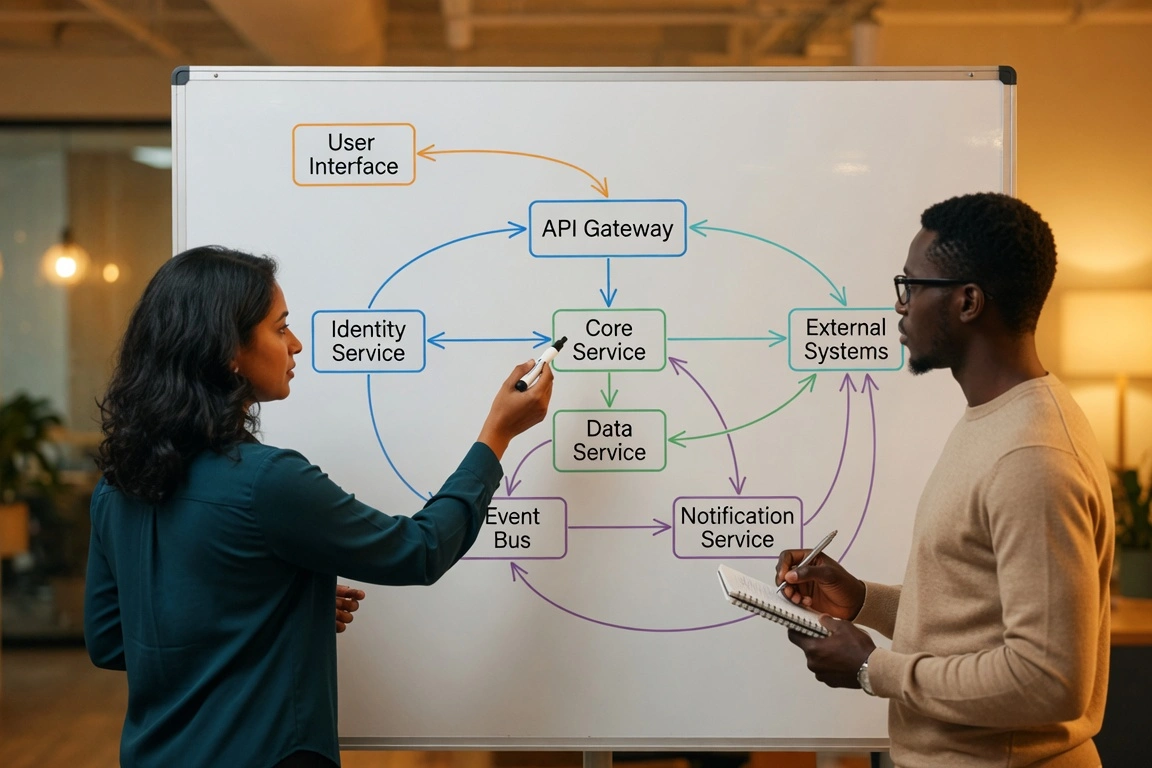
Complex orchestration is the other signal. When data flows through five or more systems — transforming formats, routing by condition, splitting into parallel processes, reconciling on the back end — you need an integration layer that handles failure states explicitly. An API call that silently fails is tolerable in a CRM sync. In a healthcare workflow, a missed message is a patient safety issue.
Tizbi®'s Legacy System Modernization work almost always involves system integration for this reason: you can't retire a 20-year-old ERP overnight. You transition gradually, running old and new in parallel, with integration as the connective tissue while the migration happens underneath.
Gartner data makes it plain: organizations with more than 100 SaaS applications — now standard at mid-size companies — rank integration complexity as their top barrier to digital transformation. The answer isn't fewer tools. It's a real integration architecture.
How Do Costs and Timelines Actually Compare?
Direct answer:
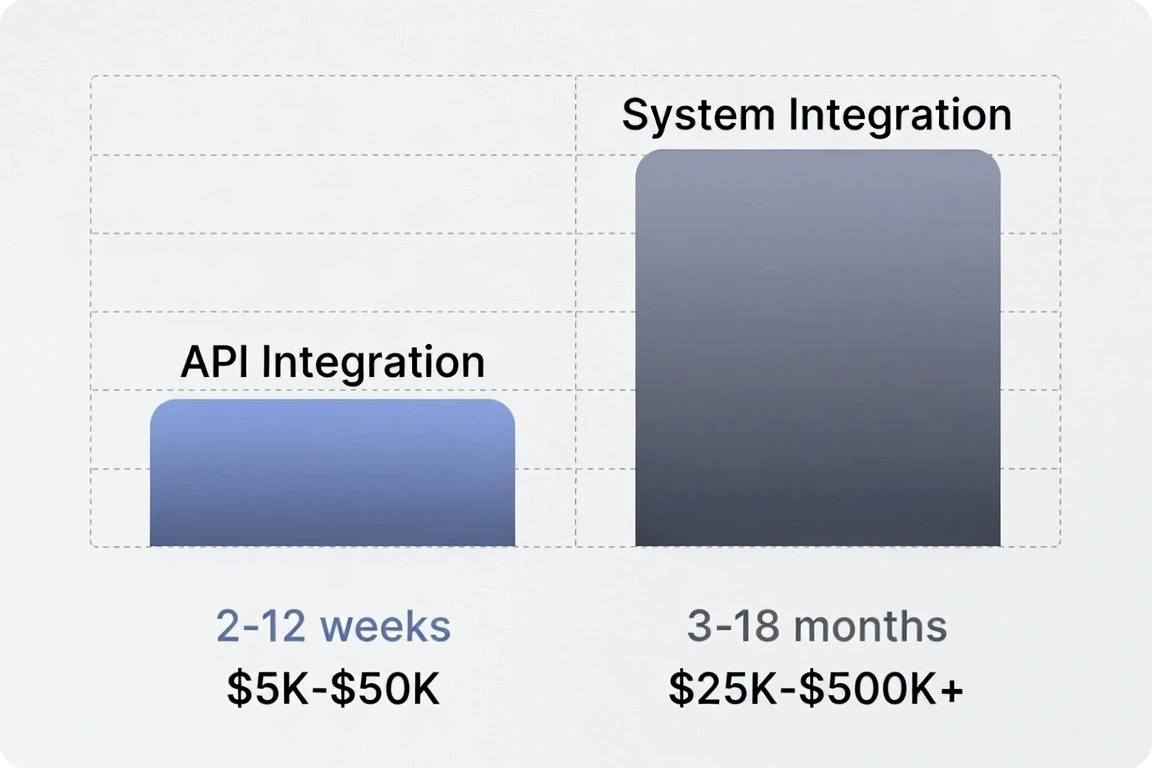
API integration: $5,000–$50,000. Timeline: 2–12 weeks.
System integration: $25,000–$500,000+. Timeline: 3–18 months.
Here's something nobody says out loud: most integration projects get over-engineered.
We've walked into rescues where a vendor sold a $300,000 middleware platform for a problem a well-built API integration would have solved for $40,000. The vendor wasn't malicious — they led with their preferred tool. But the client paid for complexity they never needed, then called us when the project stalled in month eight.
Honestly, we got this wrong ourselves early on. Years ago we defaulted to more infrastructure than some projects warranted because "robust" felt safer. Experience changed that. Now the scoping conversation comes first — always.
Our Project Rescue Teams spend significant time unwinding over-engineered integrations. The pattern is always the same: no one had the real conversation before the contract was signed.
Can You Use Both at the Same Time?
Almost always, yes. Most mature enterprise architectures run both simultaneously.
Modern systems connect through APIs at the surface. A system integration layer handles orchestration, legacy connectivity, and data transformation underneath. The APIs are the visible interface. The integration layer is what makes it reliable when something breaks.
One regional healthcare network we work with runs exactly this pattern. Their patient portal connects to scheduling and billing SaaS platforms through clean API integrations — fast, modern, well-documented. Those same SaaS platforms connect to a 12-year-old EMR with no public API through a custom system integration layer: full error handling, retry logic, audit trails.
Pull out the API integrations and the user-facing experience breaks. Pull out the system integration layer and the EMR goes dark.
If your architecture has islands of modern software surrounded by older infrastructure — and most mid-size companies do — you likely need both. The real question is sequence.
Tizbi®'s IT Consulting engagements often begin with an integration audit: map what exists, what connects today, what doesn't, and what the right architecture looks like before a line of code is written. That audit is the difference between a project that ships on schedule and one that gets rescued six months in.
What to Look for in an Integration Partner
Five questions worth asking before you sign anything.
"What happens when the integration fails?" Not if — when. A serious partner has already designed for it: dead-letter queues, retry logic, alerting, and a runbook your team can follow at 2am without calling anyone.
"Do you have references in my industry?" Integration patterns in healthcare are not the same as manufacturing, which are not the same as financial services. Specific vertical experience matters.
"Who actually does the work?" At Tizbi®, senior engineers run integration projects — not junior developers supervised from a distance. With 100+ team members across three US offices and seven international development centers, we staff complex work with people who've done it before.
"What documentation do I get?" API contracts, data flow diagrams, error handling specs, runbooks — all of it. If the answer is vague, that's information.
"What's your track record?" Tizbi® has completed 400+ projects over 28 years, with a 99% client satisfaction rate and 5+ year average client relationships. That's not a marketing claim. It's what happens when you don't cut corners.
Conclusion
The right integration approach is a scoping decision, not a technology preference.
API integration is faster, cheaper, and usually sufficient when your systems support it. System integration handles complexity that API calls alone can't. Most companies need both — sequenced deliberately, not stitched together after things break.
If you don't know which one fits your situation, that's the right place to start. Not with a quote. With a real conversation about what you're trying to connect and why.
Tizbi®'s API Integration Services team runs integration assessments before recommending an approach — no commitment to a larger project required.
Talk to us. Let's figure out which path actually makes sense for your stack.
FAQ
What is the main difference between API integration services and system integration services?
API integration connects specific applications through their published interfaces — modern SaaS tools like Salesforce, HubSpot, or Stripe. System integration is broader: it connects platforms, legacy systems, databases, and business processes, including systems with no API. API integration is faster and cheaper; system integration handles greater complexity and scale.
Can a legacy system without an API be integrated with modern software?
Yes. System integration handles this through middleware, ETL pipelines, direct database connections, or file-based transfers. Tizbi® has modernized dozens of legacy environments where API integration wasn't possible. The work is more involved, but it's well-mapped territory — not a reason to delay modernization.
How long does a typical API integration project take?
Two to six weeks for a focused connection between two well-documented SaaS platforms. Complex API projects — multiple endpoints, custom transformation logic, thorough error handling — can run to three months. Timelines compressed without proper scoping create technical debt that costs more to clean up than the original build.
What's the risk of choosing the wrong type of integration?
Using API integration for a system integration problem produces something brittle that breaks as data volumes grow or legacy systems get involved. Using system integration when API integration would suffice means over-engineering — more cost, longer timeline, and complexity that adds no value.
When should I bring in an integration consultant?
Before requirements are written. Architecture decisions made early cost nothing to change. The same decisions reversed mid-project cost months. An integration audit routinely surfaces assumptions that would have derailed the build — for a fraction of the cost of fixing them later.