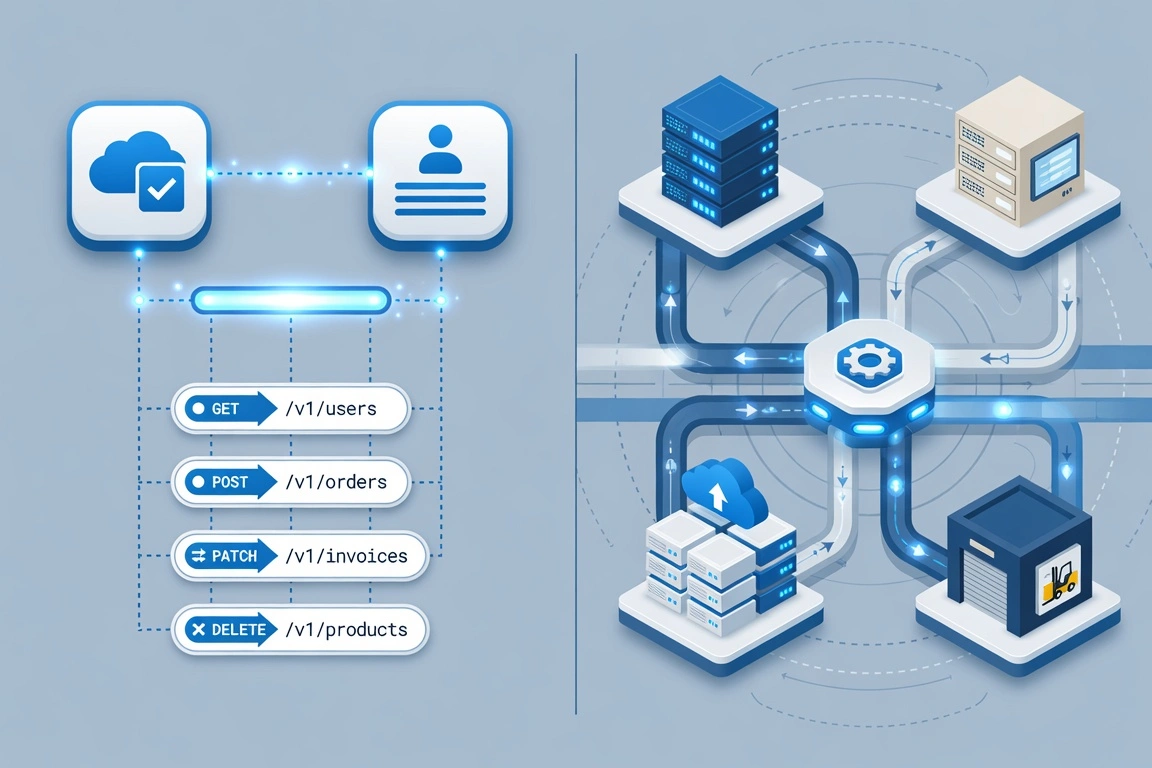
You're staring at a stack of business systems that refuse to talk to each other. Your CRM holds customer data hostage while your inventory system speaks a different language entirely. Meanwhile, your accounting software sits in the corner, completely oblivious to what's happening in sales or operations. Sound familiar?
The API integration question isn't really about technology — it's about strategy, resources, and timing. After 28+ years of helping businesses connect their digital ecosystems, Tizbi has seen companies make both brilliant and catastrophic decisions around this choice. The difference usually comes down to asking the right questions upfront.
Let's build a framework that cuts through the vendor noise and gets to what actually matters for your business.
Table of Contents
- The hidden cost of disconnected systems
- Build vs buy: understanding the full spectrum
- Key factors before making a decision
- The API integration complexity matrix
- Timeline and resource considerations
- How to evaluate total cost of ownership
- When custom development is the better choice
- When off-the-shelf platforms make sense
- Common integration mistakes businesses make
- Planning for future growth and flexibility
- How Tizbi helps companies choose the right integration path
- Frequently asked questions
The Real Cost of Disconnected Systems
Before diving into build-versus-buy decisions, let's acknowledge what drives this conversation in the first place. Disconnected systems don't just create inconvenience — they create financial bleeding that many businesses don't fully quantify.
Consider the mid-market manufacturer we worked with last year. Their production planning system couldn't communicate with their supplier portal, which meant inventory managers were manually exporting CSV files twice daily and re-keying data across platforms. The time cost alone was 15 hours per week of skilled labor. But the real damage came from the lag time — by the time production schedules reflected supplier delays, they were already promising delivery dates they couldn't meet.
This isn't unusual. Most businesses tolerate integration gaps because they've normalized the workarounds. But normalization doesn't equal efficiency, and efficiency gaps compound over time.

The Build vs Buy Spectrum (It's Not Binary)
Here's where most decision frameworks go wrong: they present build-versus-buy as a binary choice. Reality is messier and more interesting.
Pure Build: Custom development from scratch, full control, maximum flexibility.
Hybrid Build: Custom integration layer connecting existing platforms with purpose-built middleware.
Platform Integration: Using existing platform tools (Zapier, Microsoft Power Automate, native APIs).
Pure Buy: Off-the-shelf integration solutions with minimal customization.
Most successful integration strategies land somewhere in the middle, combining elements based on specific business requirements, timeline constraints, and internal capabilities.

Decision Criteria That Actually Matter
Business Criticality and Risk Tolerance
Start here: How mission-critical is this integration to your core business operations?
If you're a logistics company and real-time shipment tracking integration goes down, you're not just inconvenienced — you're potentially breaching customer contracts. High-criticality integrations typically justify more control, which often means more custom development.
Conversely, if you're connecting your office supply ordering system to your expense tracking platform, the stakes are lower. Platform-based solutions or off-the-shelf tools might provide adequate reliability without the overhead of custom development.
Data Sensitivity and Compliance Requirements
Here's where the freedom philosophy becomes a practical strategy. Not your data, not your control. Not your control, not your compliance capability.
Financial services companies learned this the hard way with third-party fintech integrations. When your integration partner experiences a security breach, your customers don't distinguish between your data and theirs. You own the compliance burden regardless of where the failure occurred.
HIPAA, SOX, GDPR — regulatory frameworks don't care about your vendor relationships. They care about data custody and control mechanisms. High-regulation environments typically justify the complexity of custom integration development because the compliance flexibility is worth more than the cost savings.
Scale and Performance Requirements
Volume changes everything. An integration that handles 100 transactions per day operates under completely different constraints than one processing 100,000 transactions per hour.
We've rescued several projects where businesses chose platform-based solutions for high-volume scenarios. The monthly costs scaled linearly with usage, but the performance didn't. By month six, they were paying enterprise-level fees for mid-market functionality while still experiencing latency issues during peak loads.
Custom integrations involve higher upfront investment but provide predictable operating costs regardless of volume. The break-even calculation depends on your growth trajectory and usage patterns.
Internal Technical Capability
Honest assessment time: What's your team's actual capability to build, deploy, and maintain custom integration infrastructure?
This isn't about technical ego — it's about sustainable operations. Custom integrations require ongoing maintenance, monitoring, and evolution as connected systems change. If your internal team lacks the bandwidth or expertise to provide that support, custom development creates more problems than it solves.
However, don't underestimate your team's capacity for learning and growth. Many businesses assume they lack integration capabilities because they've never been forced to develop them. Sometimes the build process becomes an investment in internal capability that pays dividends across multiple projects.
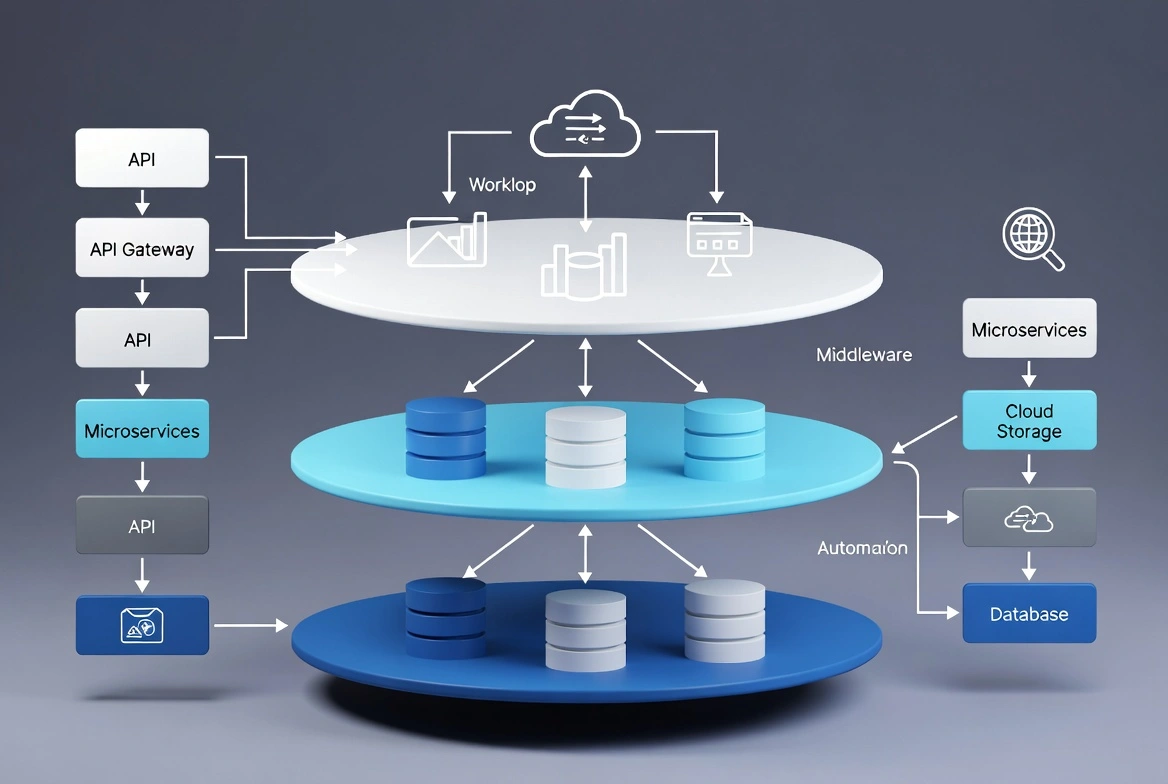
The Integration Complexity Matrix
Not all integrations are created equal. Understanding complexity upfront helps determine which approach makes sense.
Simple Integrations (Buy Territory)
Characteristics:
- Standard data formats (REST APIs, JSON)
- Infrequent updates (daily or weekly batches)
- Non-critical business processes
- Established vendor ecosystem
Examples: CRM to email marketing platform, expense tracking to accounting software, social media scheduling to content management systems.
Recommendation: Platform-based solutions or off-the-shelf integrations typically provide the best cost-benefit ratio.
Moderate Integrations (Hybrid Territory)
Characteristics:
- Mixed data formats requiring transformation
- Real-time or near-real-time requirements
- Business-critical but not mission-critical processes
- Some customization needed for business logic
Examples: E-commerce platform to inventory management, customer service platform to billing system, project management to resource planning.
Recommendation: Custom integration layer using existing platform APIs, often with middleware components for data transformation and business logic.
Complex Integrations (Build Territory)
Characteristics:
- Legacy systems with limited API capabilities
- High-volume, real-time data synchronization
- Mission-critical business processes
- Significant data transformation and business logic requirements
- Regulatory compliance considerations
Examples: ERP to manufacturing execution systems, financial trading platforms to risk management systems, healthcare records to insurance processing.
Recommendation: Custom development provides the control, performance, and flexibility required for complex scenarios.
Timeline and Resource Realities
Theory meets practice in project timelines and resource allocation. Both build and buy approaches involve hidden time costs that most businesses underestimate.
Build Timeline Factors
Custom integration development isn't just coding time. Discovery and requirements analysis typically consume 20-30% of project duration. Testing and quality assurance require another 25-35%. Deployment and initial optimization add 10-15%. The actual coding represents roughly 40% of total project time.
For businesses new to custom development, add buffer time for learning curve and requirement refinement. First-time integration projects often reveal business process gaps that weren't apparent during initial planning.
Buy Timeline Factors
Off-the-shelf solutions promise faster deployment, but implementation timelines depend heavily on configuration complexity and data migration requirements. Platform-based integrations might take days to configure but weeks to test thoroughly with real business data.
Vendor dependency introduces timeline variables outside your control. Support response times, feature requests, and bug fixes operate on the vendor's schedule, not yours. Factor this dependency into critical path planning.
Making the Decision: A Practical Framework
Step 1: Score Your Requirements
Assign weights based on your specific business context:
Control Requirements (0-10): How important is direct control over integration logic, performance, and modifications?
Compliance Sensitivity (0-10): How strictly regulated is your industry, and how sensitive is the data being integrated?
Performance Criticality (0-10): How significantly would integration downtime or latency impact business operations?
Budget Flexibility (0-10): How much upfront investment can you allocate to integration infrastructure?
Internal Capability (0-10): How strong is your team's ability to build and maintain custom integration solutions?
Step 2: Calculate Total Cost of Ownership
Look beyond initial development costs:
Custom Build TCO:
- Development costs (discovery, coding, testing, deployment)
- Infrastructure costs (hosting, monitoring, security)
- Maintenance costs (updates, bug fixes, performance optimization)
- Opportunity costs (internal resources allocated to integration vs. core business)
Platform/Buy TCO:
- Platform fees (often scaling with usage)
- Configuration and setup costs
- Data migration costs
- Vendor management overhead
- Switching costs if platform doesn't meet evolving needs
Step 3: Assess Risk Tolerance
Build Risks:
- Development timeline overruns
- Technical complexity underestimation
- Internal resource constraints
- Maintenance burden over time
Buy Risks:
- Vendor dependency and lock-in
- Limited customization capability
- Scaling cost unpredictability
- Integration discontinuation or acquisition
When to Choose Custom Development
Custom integration development makes sense when several factors align:
You need integration logic that doesn't exist in off-the-shelf solutions. Standard platforms excel at common integration patterns but struggle with industry-specific or company-specific business logic.
Data volume or performance requirements exceed platform capabilities. High-frequency trading firms don't use Zapier for market data integration, and high-volume e-commerce operations often outgrow standard platform-based solutions.
Regulatory compliance requires specific data handling or audit capabilities. Custom development provides the transparency and control necessary to demonstrate compliance with detailed regulatory requirements.
Integration represents core competitive advantage. If your integration capability differentiates your business offering, custom development protects that advantage from vendor dependency.
When to Choose Platform Solutions
Platform-based integration tools provide excellent value when:
Integration requirements align with standard business processes. Most CRM-to-marketing automation integrations follow predictable patterns that platforms handle efficiently.
Speed to deployment outweighs customization needs. Sometimes getting 80% of desired functionality deployed in weeks beats waiting months for 100% custom solution.
Internal technical resources are limited or allocated to higher-priority projects. Platform solutions reduce internal maintenance burden and technical debt.
Integration represents business hygiene rather than competitive advantage. Connecting your HR system to your payroll platform improves operations but rarely creates market differentiation.
Red Flags and Warning Signs
Certain scenarios consistently lead to integration project failures regardless of approach chosen:
Proceeding without clear business requirements. “We need our systems to talk to each other” isn't a specification — it's a symptom. Successful integrations start with specific business process requirements.
Underestimating data quality issues. Integration projects often reveal data inconsistencies, duplications, and format problems that weren't apparent when systems operated independently. Clean your data before connecting your systems.
Ignoring change management requirements. Integration changes how people work. Factor training, process documentation, and user adoption into project planning.
Assuming integration solves process problems. Integration amplifies existing processes — both efficient ones and broken ones. Fix your processes before automating them.
Planning for Evolution
The best integration decisions account for future business evolution. Both custom and platform-based solutions need upgrade paths as businesses grow and change.
Custom integrations provide maximum flexibility for future modifications but require ongoing development capability. Platform solutions offer easier feature additions as vendors expand capabilities but may not evolve in directions aligned with your specific business needs.
Consider your business trajectory: Are you growing rapidly and need integration flexibility to support changing requirements? Or are you in a stable industry with predictable integration needs where platform reliability matters more than customization capability?

Your Next Steps
Integration decisions don't have to be permanent, but they do have momentum. Poor integration architecture creates technical debt that becomes more expensive to resolve over time.
Start with clear business requirements rather than technical specifications. What business processes need improvement? What manual work should be automated? What data needs to be accessible to which teams? Technology decisions flow from business requirements, not the reverse.
If you're still uncertain about the right approach for your specific situation, that's completely normal. Integration projects involve complex trade-offs between competing priorities. At Tizbi, we've helped 400+ businesses navigate these decisions over 28+ years. We believe in starting with your business needs and working backward to the right technical approach — whether that involves custom development, platform integration, or hybrid solutions.
Want to explore what the right integration strategy looks like for your specific business context? Let's have a conversation about your requirements, constraints, and objectives. No sales pitch, no artificial urgency — just an honest discussion about what actually works in practice.
Frequently Asked Questions
Should my business build a custom API integration or buy an existing solution? It depends on business criticality, data sensitivity, scale, and your internal technical capability. Simple, standard integrations (like CRM to email marketing) usually favor buying, while complex, high-volume, or regulated integrations usually justify custom development. A structured API integration assessment is the fastest way to score your specific situation.
What's the biggest hidden cost of sticking with disconnected systems? It's rarely the manual labor itself; the more likely culprit is the lag time. Teams re-keying data between platforms often don't notice the compounding effect until a downstream decision (like a delivery date or a customer commitment) is made on stale information.
Is build-vs-buy really an either/or decision? No, most successful integration strategies land somewhere in the middle, combining a custom integration layer with existing platform tools rather than going all-in on one approach.
How do regulatory requirements like HIPAA or GDPR affect the build-vs-buy decision? Regulated environments typically push toward custom development, because compliance frameworks care about data custody and control, not vendor relationships. If a third-party integration partner has a breach, your business owns the compliance burden regardless of where the failure occurred.
What's a common mistake businesses make when scaling an integration? Choosing a platform-based solution for a high-volume use case. Platform fees often scale linearly with usage, but performance doesn't. It's common to end up paying enterprise-level fees for mid-market functionality while still hitting latency issues at peak load.
How long does a custom API integration typically take to build? Coding itself is usually only about 40% of total project time; discovery and requirements analysis (20-30%), testing and QA (25-35%), and deployment and optimization (10-15%) make up the rest. First-time integration projects should budget extra time, since they often surface business process gaps that weren't visible until systems were actually connected.
How do I know if my integration is simple, moderate, or complex? Simple integrations use standard data formats and infrequent, non-critical updates. Moderate integrations involve real-time requirements and some custom business logic. Complex integrations typically involve legacy systems, high-volume real-time sync, and regulatory considerations (see the complexity matrix in this article for specific examples of each).
Where should I start if I'm not sure which approach is right for my business? Start with your business requirements, not the technology. What manual work should be automated, and what data needs to reach which teams? Tizbi has helped 400+ businesses work through exactly this decision, reach out for a conversation about your specific constraints.