There is a moment most growing businesses recognize, even if they cannot name it right away. The spreadsheet that was supposed to be temporary is now mission-critical. Your team has built seven workarounds inside a SaaS platform that was never designed for the way you actually operate. Every Monday someone manually exports data from one tool and imports it into another. You are paying for three software subscriptions that do roughly the same thing, none of them exactly right.
Or maybe the opposite: a well-meaning consultant convinced you that custom software was the answer, and twelve months later you are sitting on a half-built system, a strained budget, and a development relationship that has quietly gone sideways.
Both of these stories are real. We have watched both of them unfold, more times than we can count.
The custom software vs. SaaS question is not a technology question. It never was. It is a business question about where you are, where you are going, and what is genuinely standing between you and getting there. This article is designed to help you think through that question clearly, without a vendor agenda behind every paragraph.
Table of Contents
- Why the Standard Advice Usually Misses the Point
- Start With the Problem, Not the Product
- The Decision Framework: Four Questions That Actually Matter
- When SaaS Is the Right Answer
- When SaaS Stops Working
- The Real Cost Conversation
- A Decision Matrix for SMBs
- The Discovery Question
- What This Decision Actually Comes Down To
- A Final Word on Partnership
- Frequently Asked Questions
Why the Standard Advice Usually Misses the Point
Search "custom software vs. SaaS" and you will find a lot of comparison tables. Feature columns. Price ranges. Timelines. They are not wrong, exactly, but they start in the wrong place. These pinpoint the tools, not the business.
The real question is not "which type of software is better?" The real question is: what problem are you actually trying to solve, and what does solving it correctly require?
A $79/month SaaS tool can be exactly the right answer for a specific problem at a specific stage of a business. A custom-built system can be the only thing that unlocks the next chapter of growth. Neither is universally superior. The mistake is treating this as a category competition when it is actually a diagnostic exercise.
Here is how to run that diagnostic honestly.
Start With the Problem, Not the Product
Before you evaluate any software option, write down — in plain language, not technology language — what is actually broken or missing in your operation right now.
Not "we need a better CRM." Something more like: "Our sales team cannot see the service history of a customer when they are on a call, so they make promises that operations cannot keep, and we lose renewal business because of it."
That level of specificity changes everything. A "better CRM" might be Salesforce. But the actual problem — disconnected sales and service data leading to broken promises — might require something that connects your CRM to your service management system in a way neither platform supports natively.
The problem statement is the foundation. Everything else is built on top of it.
The Decision Framework: Four Questions That Actually Matter
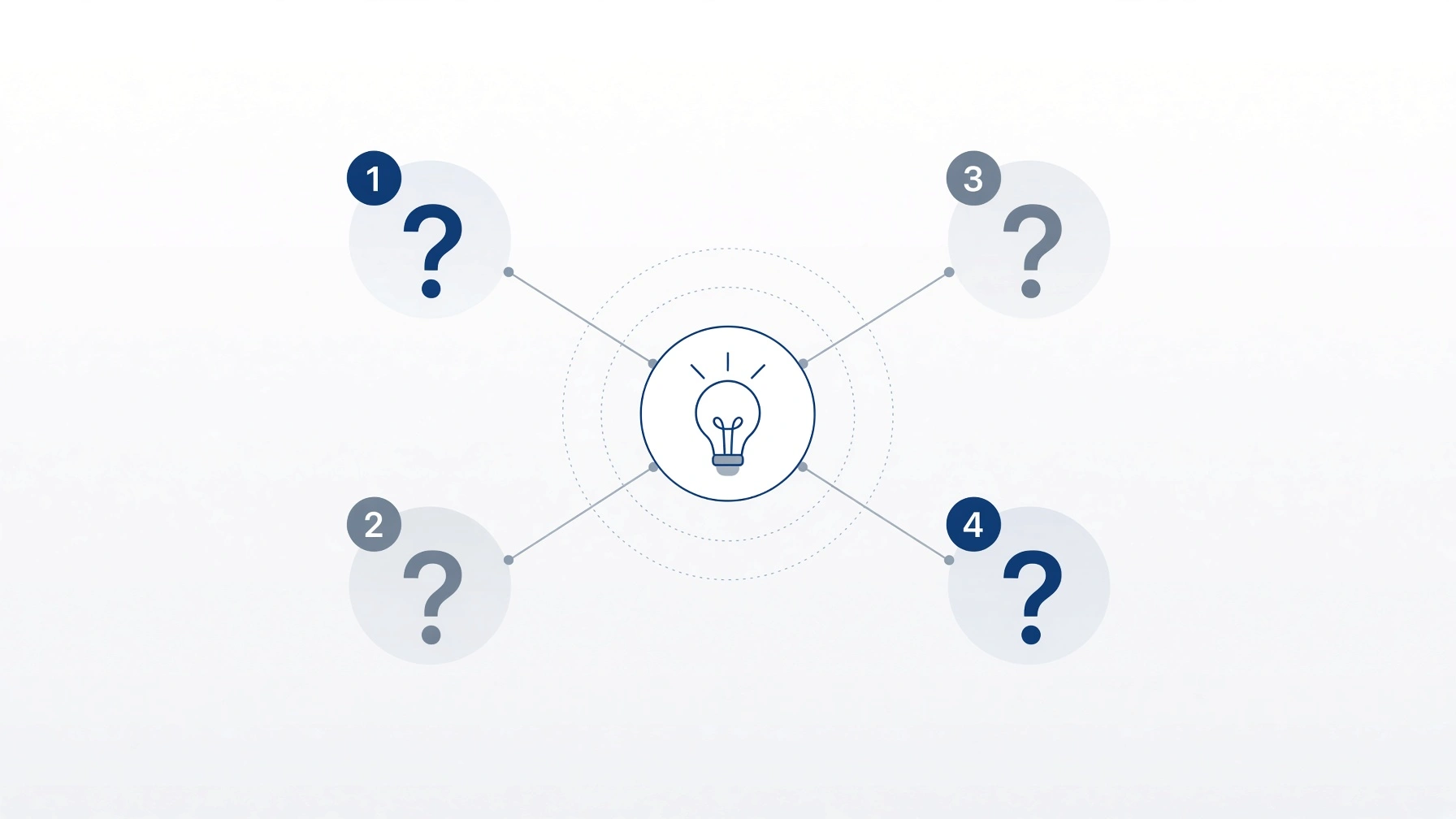
Question 1: Is Your Process Standard or Differentiated?
Some business processes are universal. Sending invoices. Managing employee PTO. Tracking sales leads through a pipeline. These processes are essentially the same across thousands of businesses, which is exactly why SaaS tools built around them are so effective. Somebody has already solved this problem, many times over, and you can rent that solution for a very reasonable monthly fee.
But some processes are not universal. They are the product of how your specific business operates, refined over years, shaped by your industry, your customers, your team. When your competitive edge lives inside a process, handing that process over to a generic SaaS platform has real costs: you are now constrained by someone else's design decisions, and the workflow that makes you different has to bend to fit a tool that was never designed around it.
Ask yourself: if a direct competitor signed up for the same SaaS platform tomorrow, would they instantly be able to replicate what you do? If the answer is yes, that is not necessarily a problem, it means the process is standard enough for a standard tool. If the answer is no, that differentiation is worth protecting, and protection often means ownership.
Question 2: Where Does Your Data Actually Live, and Who Controls It?
This question matters more than most businesses realize until it is too late.
SaaS platforms store your data in their infrastructure, under their terms. When you close your account (or when they change their pricing, get acquired, sunset a feature, or simply decide to restructure their product) your data is subject to their decisions, not yours.
For some categories of business data, this is an acceptable tradeoff. For others, it is existential. If your customer data, your operational data, or the intellectual product of your business lives inside a SaaS platform, ask yourself what it would cost: in time, money, and operational disruption, if you lost clean access to that data tomorrow. If the answer is "significant," you have a data custody problem that SaaS cannot solve and custom development can.
Your data is a business asset. In the AI era, it is increasingly the business asset. Systems that give you full ownership and control over that data are not a luxury consideration, they are a strategic one.
Question 3: What Is the Actual Cost of the Workaround?
Every business running a process through the wrong tool has workarounds. The question is whether anyone has actually added up what those workarounds cost.
One of our clients, a mid-sized operations company, had a team of three people whose primary job was moving data between two SaaS systems that could not talk to each other. When we sat down and calculated the salary cost of that manual process, plus the error rate and the downstream operational problems those errors caused, the number was startling. The custom integration that would have eliminated the problem entirely cost less than one year of the workaround.
Workarounds have a way of becoming invisible because they feel like "just how things work." They are not invisible in your P&L. They show up as headcount, as overtime, as errors, as delays, as customer complaints. Before you decide that custom software is too expensive, calculate what you are already spending on the status quo.
Question 4: Where Is Your Business in Twelve Months?
Software decisions made for the business you are today may not serve the business you are becoming.
SaaS scales easily in some directions: adding seats, expanding storage, enabling more users. It scales poorly in others, when your process complexity outgrows the platform's design, or when you need capabilities the vendor has not built and may never build.
Custom software requires upfront investment that SaaS does not. But it also gives you a system that can evolve exactly as your business evolves, without being constrained by a vendor's product roadmap.
The honest version of this question: are you building toward a business model that is genuinely differentiated, where technology is a core part of how you deliver value? Or are you running a business where technology is infrastructure; necessary but not competitive? The answer shapes which direction makes sense.
When SaaS Is the Right Answer
We will say this plainly, because a lot of custom development shops won't: SaaS is the right answer more often than the custom software industry would like to admit.
If you are a business with standard workflows, a reasonable budget, and a problem that a well-designed SaaS product already solves, use the SaaS product. It will be faster to deploy, lower in upfront cost, and someone else's responsibility to maintain and upgrade.
SaaS is especially strong when:
- You are early-stage and still discovering what your processes actually need to look like
- The workflow is administrative rather than core to your value delivery
- You need something running in weeks, not months
- Your team does not have the internal capacity to manage a custom system
- The problem is well-defined and the market has already built good solutions around it
There is no virtue in building custom software when an off-the-shelf tool does the job well. Complexity for its own sake is not sophistication, it is cost without a corresponding return.
 Trusted Software & AI Partner
28+ Years of Experience
400+ Projects Delivered
99% Client Satisfaction
Trusted By



When SaaS Stops Working
The signs are usually visible before the crisis. Most businesses just learn to live with them.
You are managing software instead of running your business. When your team spends meaningful time each week navigating platform limitations, exporting and re-importing data, maintaining the integration "glue" between tools, or training staff on workarounds, the software is managing you, not the other way around.
You are paying for the platform's priorities, not yours. SaaS vendors build features for their median customer. If your business is not the median customer, for example, if you have industry-specific needs, unusual data relationships, or a workflow that does not map cleanly to the platform's assumptions, you will pay for a long list of features you will never use while waiting indefinitely for the one feature you actually need.
Data lives everywhere and belongs to no one. When your customer record exists in four different systems and none of them have the complete picture, operational decisions get made on incomplete information. Integrations help, but they introduce their own fragility. There is a category of data architecture problem that integrations can patch but cannot cure.
You have outgrown the platform's performance ceiling. Some SaaS products are built for a certain scale. When you push past that scale (in data volume, in transaction frequency, in user complexity) you start hitting walls the vendor designed into the product. Those walls are not bugs. They are architectural decisions that made sense for the target market. They are just not your market anymore.
The platform has become a competitive ceiling. If your competitors use the same SaaS tool and you are all constrained to the same feature set, the tool has become an equalizer rather than an advantage. Custom systems let you build what others cannot buy.
The Real Cost Conversation
Cost is where this conversation usually gets derailed, so it is worth being honest about it.
Custom software is more expensive upfront. That is simply true, and anyone who tells you otherwise is setting you up for a bad surprise. A well-scoped custom development project for an SMB might run anywhere from $40,000 to $300,000 or more depending on complexity, integrations, and timeline. That is a real number. It deserves serious consideration.
But "custom software is expensive" is only half the analysis. The other half is what you are already spending, what you are losing, and what you would gain.
The businesses that do well with custom software are the ones who do that full analysis before they commit. They can point to a specific operational cost, a specific growth constraint, or a specific competitive disadvantage that custom software is designed to address, and they can quantify it well enough to evaluate the return.
The businesses that regret custom software investments are usually the ones who bought the idea before they bought the outcome. They were sold on technology capabilities before anyone asked hard questions about the business problem.
The discipline of starting with the problem: defining it precisely, costing the current state, projecting the value of the solution, is what separates a good software investment from a regrettable one. It is also what a good development partner will insist on before writing a single line of code.
A Decision Matrix for SMBs
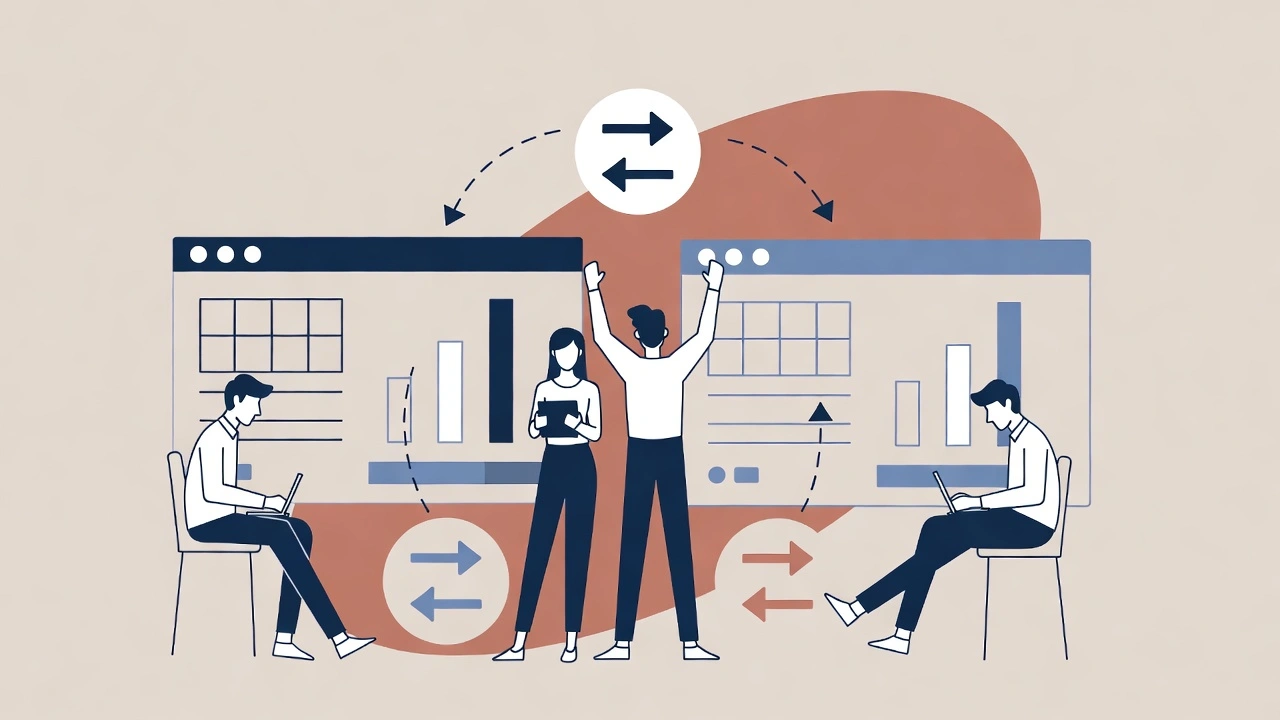
Use this as a starting point, not a final answer. Your situation has details that a grid cannot capture.
| Signal | Lean Toward SaaS | Lean Toward Custom |
|---|---|---|
| Process type | Standard, shared by most businesses | Unique to your operation or industry |
| Data ownership needs | Acceptable to store with vendor | Must own and control |
| Stage of business | Early, still discovering needs | Established with stable, differentiated workflows |
| Competitive role of technology | Infrastructure, not differentiator | Core to how you deliver value |
| Integration needs | Standard APIs, few systems | Complex, proprietary, or high-volume |
| Workaround cost | Minimal | Significant (labor, errors, delays) |
| Timeline | Need it in weeks | Can invest 3–9 months for the right solution |
| Budget | Prefer predictable monthly opex | Can evaluate total cost of ownership over 3–5 years |
The Discovery Question
One thing competitors in this space rarely say: if you cannot clearly define your business problem before you talk to a developer, you are not ready for custom software yet.
That is not a criticism. It is a genuine observation about where projects go wrong. The development process cannot substitute for business clarity. If you start building before you know what you are building toward, and why, the result will reflect that uncertainty.
The right first step with any development partner worth working with is not a proposal. It is a conversation. A good discovery process will surface the real problem, evaluate whether custom software is actually the right solution, estimate realistic cost ranges before anyone commits to anything, and give you enough information to make a decision with your eyes open.
If a developer skips directly from "tell me what you want" to "here is a contract," that is a warning sign. The most useful thing a development partner can do early in the process is slow down and ask harder questions, including, when appropriate, "are you sure you need custom software?"
What This Decision Actually Comes Down To
Strip away the feature comparisons, the pricing models, the technology choices, and the vendor positioning, and the build-vs-buy decision comes down to two things:
- How central is this process to your business? The more your competitive position, your customer experience, or your operational capability depends on a specific workflow, the more that workflow deserves to be under your control.
- What is the true cost of not solving this correctly? Not just the software cost: the full cost. The workarounds, the lost opportunities, the data you cannot use, the decisions you cannot make because the right information is not in the right place.
When those two things are genuinely significant, custom development is worth serious consideration. When they are not, a well-chosen SaaS tool is almost certainly the smarter path.
A Final Word on Partnership
The last thing worth saying here is this: the quality of your development partner matters as much as the build-vs-buy decision itself.
A good partner will tell you when SaaS is the better answer. They will start with your business problem and work backward to the technology, not the reverse. They will be transparent about costs, timelines, and risks, including the risks of building, and they will not disappear after launch. They will care about whether the software actually solves the problem it was built to solve.
That kind of relationship is rarer than it should be in this industry. It is also the only kind worth investing in.
If you are working through this decision and want a second opinion from a team that has been in these conversations for a long time, not to sell you on custom development, but to help you think it through correctly, we are happy to talk.
Start with a free discovery conversation →
Frequently Asked Questions
These are the questions we hear most often, from founders weighing a $400/month SaaS subscription against a six-figure custom build, from operations managers buried in workarounds, and from executives who've been burned by both choices. We've answered them as honestly as we can.
The Basics
What's the actual difference between custom software and SaaS? SaaS (Software as a Service) is software someone else built, hosts, and maintains; you pay for access, usually monthly or annually. Think Salesforce, QuickBooks, HubSpot. You get a working product on day one, but you work within its rules.
Custom software is built specifically for your business. Your workflows, your data model, your logic. You own it. No one else's roadmap dictates what it can do next.
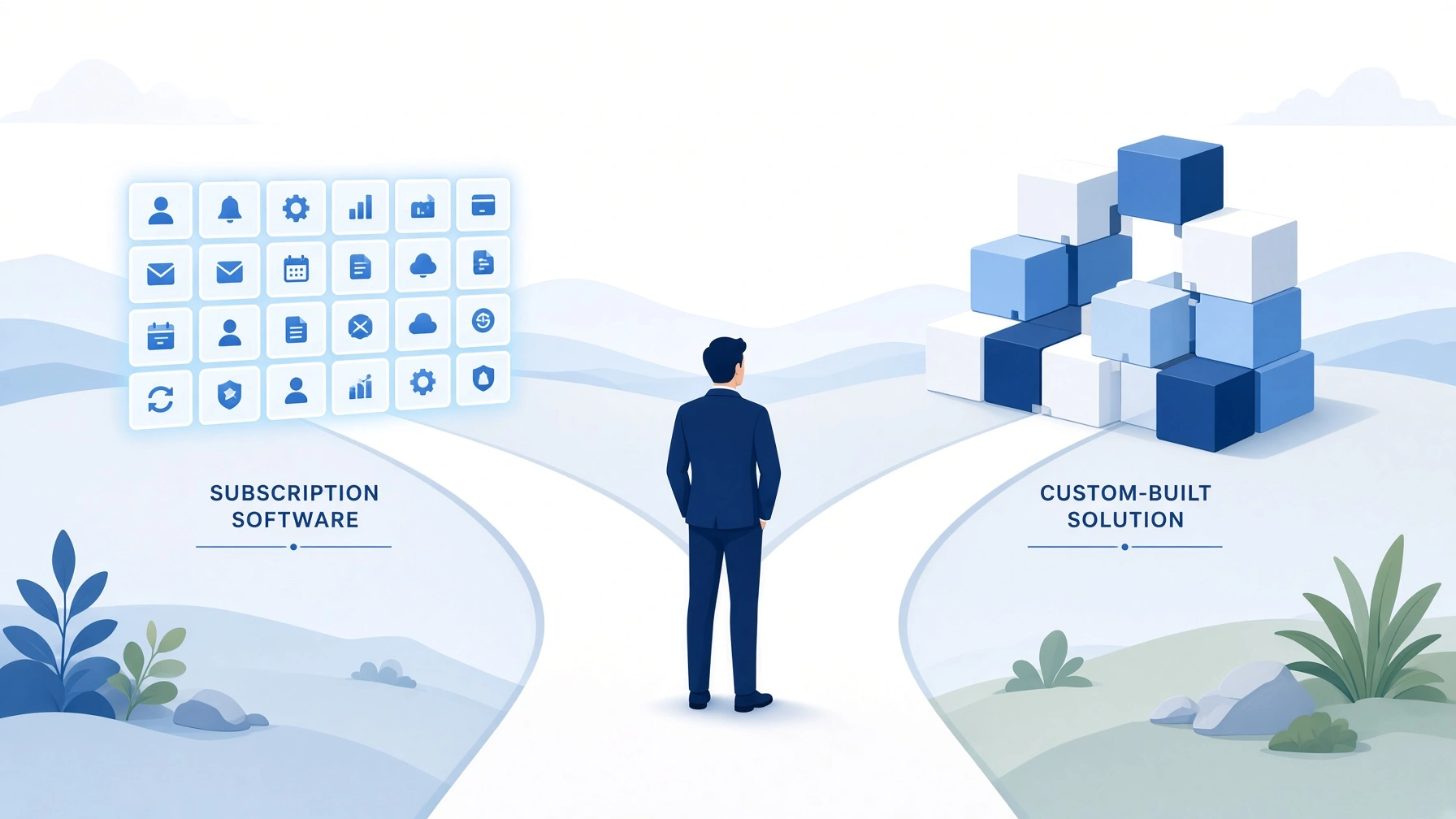
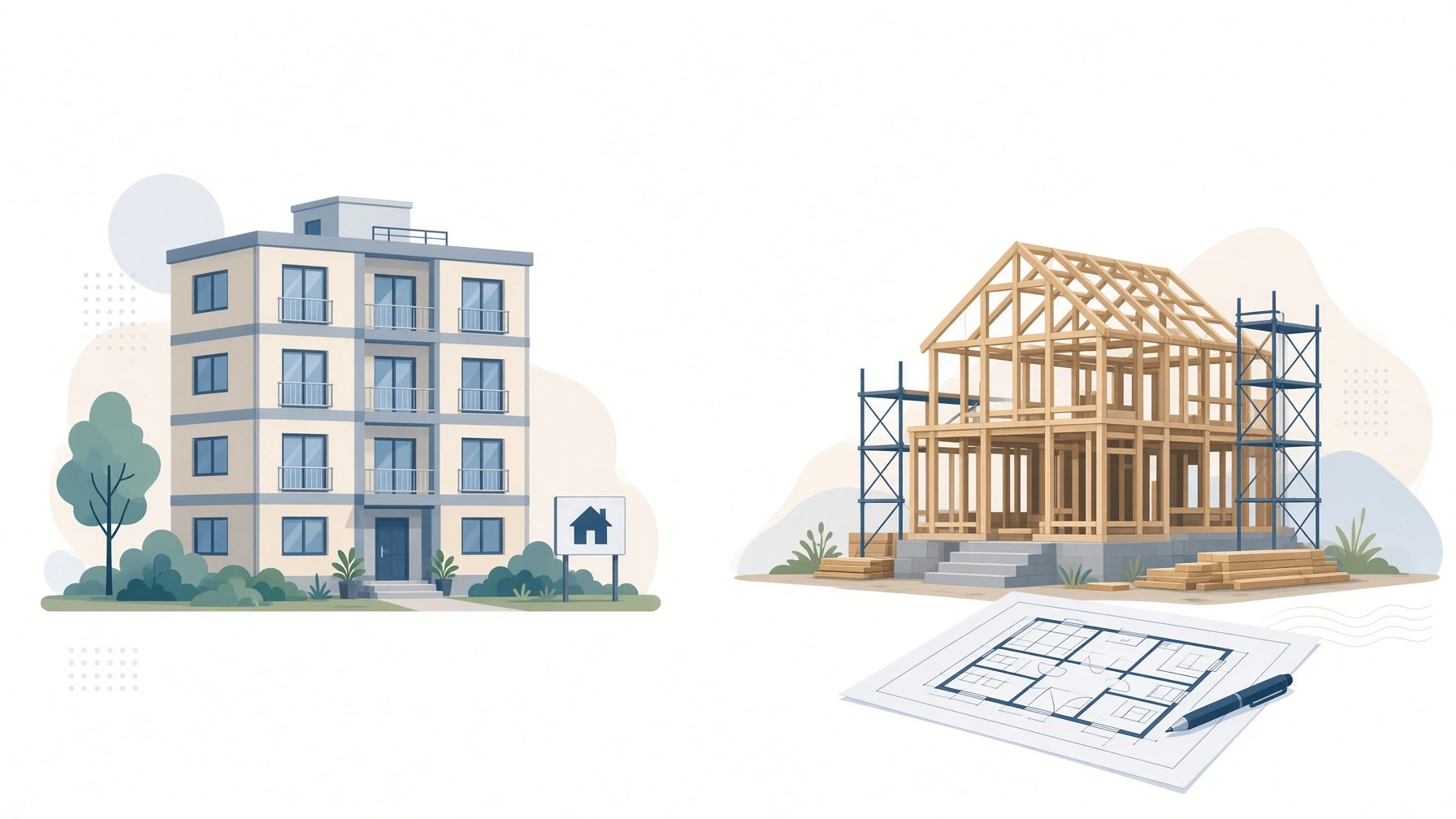
The simplest way to think about it: SaaS is renting a furnished apartment. Custom software is building a house. Renting is faster and cheaper to start. Building gives you exactly what you need, and you own the asset when you're done.
Is custom software always better than SaaS? No, and anyone who tells you otherwise is selling something.
SaaS is genuinely the right answer for a large category of business functions: accounting, email, HR, project management, customer support ticketing. These are solved problems. Mature SaaS products have invested millions of hours in features, security, and compliance that no custom build can replicate at a reasonable price.
Where custom software earns its cost is in the processes that make your business yours, the workflows that don't map to any dropdown menu, the integrations that SaaS platforms can't quite reach, the data relationships that don't fit someone else's schema.
How much does custom software cost compared to SaaS? SaaS costs are predictable and front-loaded toward low friction. Custom software costs vary widely based on complexity, with ongoing maintenance costs after that. That sounds steep until you run the math on what you're paying in SaaS fees, manual labor to fill the gaps, and lost productivity from workarounds across five years.
The honest answer: custom software usually costs more upfront and less over a long enough time horizon, especially once you factor in the business value of actually solving the problem rather than approximating a solution.
Making the Decision
How do I know when SaaS has stopped working for my business? Watch for these signals:
- Your team has built a shadow workflow in spreadsheets or email alongside the SaaS tool
- You're paying for features you don't use while the features you actually need aren't available
- Reporting requires manual exports and reformatting every time
- You've submitted the same feature request to your vendor for two years
- Onboarding new employees requires teaching them your workarounds, not just the software
When your people are spending meaningful time fighting the tool instead of using it, the SaaS is no longer serving the business; the business is serving the SaaS.
Can I integrate custom software with the SaaS tools I already use? Usually, yes, and this is one of the most underappreciated aspects of custom development. A well-built custom application can pull data from your existing CRM, push updates to your accounting platform, and sync with your project management tools via API. You don't have to throw everything out to build something custom.
In many cases, the custom software becomes the connective layer between platforms that don't talk to each other, replacing a tangle of manual exports and copy-paste workflows with something automated and reliable.
What questions should I ask before deciding to build? Before committing to a custom build, get clear on these:
- Is this problem truly unique to my business, or does a SaaS product already solve it well?
- What does this problem cost me today, in dollars, hours, or missed opportunities?
- Do I have a clear picture of the requirements, or am I still figuring out what I actually need?
- Can my organization absorb a 6–12 month development process, including time to give feedback and test?
- Who will own and maintain this after it's built?
If you can't answer most of these confidently, a discovery engagement, before any development begins, is usually worth more than jumping straight into a build.
The Build Process
How long does it take to build custom software? A simple internal tool with narrow scope: three to five months. A full business application with multiple user roles, integrations, and reporting: nine to eighteen months is realistic. Complex platforms can run longer.
The variable that most people underestimate isn't the development time; it's the time their own team spends reviewing, giving feedback, and making decisions during the build. That's not overhead; it's the work of making sure what gets built is what you actually needed.
What does a responsible development process look like? At minimum, it should include:
- A discovery phase before any code is written
- Transparent budget tracking throughout: you should know where every dollar is going, not just get a quarterly update
- Regular working demos, not just status reports
- Honest escalation when something is taking longer or costing more than expected
- Testing. More testing. Then testing again.
If a development partner can't tell you what you'll spend in a given week or month, that's a structural problem, not a billing quirk.
What happens if my needs change mid-project? They will change. Every project encounters this. The question is whether your development partner has a process for handling it: transparent change orders, honest conversations about scope and cost, and a shared understanding of what shifting priorities means for the timeline.
What you don't want is a partner who quietly absorbs scope changes until the budget is gone, or one who refuses to adapt at all. Neither ends well.
Working With a Development Partner
How do I evaluate a custom software development firm? Look for a few things that are easy to check and hard to fake:
- A real track record: completed projects, client references you can actually call, longevity in the market
- Transparency about process: they should be able to explain exactly how they manage budget and scope before you sign anything
- Honest conversations about fit: a good partner will tell you if your project isn't ready or if SaaS is a better answer right now
- Post-launch support: what happens after the software is delivered? Who do you call?
Be cautious of firms that lead with technology and never ask about your business. The first conversation should be mostly about your problem, not their stack.
Do you always recommend custom software? No. When a client comes to us with a business problem that a well-established SaaS product already solves at a price that makes sense, we say so. We've talked plenty of prospective clients out of custom builds, and those conversations tend to be the start of long relationships, because clients trust that we're giving them straight advice, not a sales pitch.
Ready to Think This Through for Your Specific Situation?
Every business decision here depends on context that a FAQ page can't capture. If you're weighing the custom vs. SaaS question for your business right now, we're glad to talk through it, no commitment required.