The conference room falls silent when someone asks the inevitable question: “What's our return on investment from the chatbot project?”
If your answer involves response time improvements and conversation volume metrics, you're measuring the wrong things. After 28 years of building custom software solutions, Tizbi has learned that the most expensive enterprise technology implementations are the ones that work exactly as specified — but fail to move the business needle.
Enterprise chatbots represent a $1.25 billion market precisely because they promise to solve real business problems. Yet most ROI discussions focus on technical performance rather than business outcomes. The chatbot responds in 2.3 seconds instead of 8. It handles 40% more conversations. Customer satisfaction scores tick up marginally.
Meanwhile, the fundamental business challenge — whether that's reducing operational costs, increasing revenue per customer, or accelerating internal processes — remains largely unchanged.
Table of Contents
- The ROI Measurement Problem Most Enterprises Face
- The Business-First Framework for Chatbot ROI
- Hidden ROI Factors Enterprises Often Overlook
- Long-Term Value vs. Implementation Costs
- Industry-Specific Chatbot ROI Patterns
- Chatbots as System Integration Layers
- Common Enterprise Chatbot ROI Mistakes
- Building a Sustainable ROI Framework
- The Partnership Approach to Enterprise AI Solutions
The ROI Measurement Problem Most Enterprises Face
Traditional chatbot ROI calculations suffer from what we call “implementation tunnel vision.” Organizations become so focused on getting the technology working that they lose sight of why they needed it in the first place.
Consider the typical enterprise chatbot metrics dashboard:
- Average response time: 1.8 seconds
- Conversation completion rate: 78%
- User satisfaction score: 4.2/5
- Monthly active conversations: 12,000
These numbers tell you the chatbot is functioning. They don't tell you whether your business is healthier.
The real ROI question isn't whether your chatbot works — it's whether your chatbot solves the business problem that justified its existence. This requires measuring outcomes, not outputs.

The Business-First Framework for Chatbot ROI
At Tizbi, we start every enterprise chatbot engagement with discovery, not development. Before a single line of code gets written, we map the business case against measurable outcomes. Here's how that process works:
Identifying the Core Business Driver
Most enterprises implement chatbots for one of four fundamental reasons:
Cost Reduction — Deflecting expensive human interactions to automated systems. The ROI measurement here is straightforward: cost per interaction before and after implementation, multiplied by interaction volume.
Revenue Generation — Using conversational AI to identify sales opportunities, cross-sell existing customers, or reduce friction in purchasing processes. Success metrics include conversion rates, average order value, and sales cycle acceleration.
Operational Efficiency — Streamlining internal processes like HR inquiries, IT support, or knowledge management. ROI shows up as reduced time-to-resolution, increased employee productivity, or improved process consistency.
Risk Mitigation — Ensuring compliance, reducing human error, or providing consistent information across customer touchpoints. These benefits often appear as avoided costs rather than direct savings.
The key insight: your chatbot ROI framework must align with your primary business driver. A cost-reduction chatbot measured on engagement metrics will appear successful while failing its actual purpose.
Establishing Baseline Measurements
Here's where most enterprises stumble. They implement chatbots without establishing clear baseline measurements for their target business outcomes.
If your chatbot is designed to reduce support costs, you need to know:
- Current cost per support interaction
- Volume and type distribution of support requests
- Resolution time by request category
- Escalation rates to human agents
- Customer satisfaction with current support processes
If your chatbot targets revenue generation:
- Conversion rates at each stage of the customer journey
- Average revenue per customer interaction
- Time from initial inquiry to purchase decision
- Cross-sell and upsell success rates
- Customer lifetime value by acquisition channel
Without baseline measurements, you're essentially flying blind. You might build a technically impressive chatbot that delivers no measurable business value.
Beyond the Obvious: Hidden ROI Factors
The most significant enterprise chatbot ROI often comes from unexpected places. In our experience building custom solutions for businesses across industries, the secondary benefits frequently outweigh the primary ones.
Data Intelligence and Customer Insights
Every chatbot conversation generates structured data about customer needs, pain points, and behavior patterns. This intelligence often proves more valuable than the conversation itself.
One manufacturing client implemented a customer service chatbot primarily to reduce support costs. Within six months, conversation data revealed that 40% of support requests stemmed from a single product configuration issue. Fixing that underlying problem eliminated thousands of future support interactions and improved customer satisfaction more than the chatbot itself.
The ROI calculation expanded beyond cost-per-interaction to include product improvement value and reduced churn risk.
Process Standardization and Knowledge Capture
Enterprise chatbots force organizations to codify tribal knowledge and standardize processes. This creates value that extends far beyond the chatbot's direct interactions.
A professional services firm used a chatbot to handle employee onboarding questions. The process of building the chatbot revealed inconsistencies in HR policies across different departments. Standardizing these policies reduced confusion, improved compliance, and accelerated new employee productivity — benefits that showed up in employee satisfaction surveys and time-to-productivity metrics rather than chatbot performance data.
Scalability Without Proportional Cost Increases
Traditional customer service scales linearly — more customers require more support staff. Chatbots create step-function scaling opportunities where interaction volume can increase dramatically without proportional cost increases.
This scaling benefit doesn't appear in early ROI calculations because it represents potential rather than realized value. However, for growing enterprises, this scalability often justifies chatbot investment even when immediate ROI appears marginal.
Measuring Long-Term Value vs. Implementation Costs
Enterprise chatbot ROI discussions often suffer from mismatched time horizons. Implementation costs are immediate and obvious. Business value accrues over months or years.
The Total Cost Reality
True chatbot implementation costs include:
- Development and customization
- Integration with existing systems
- Staff training and change management
- Ongoing maintenance and updates
- Opportunity costs during implementation
Most enterprises underestimate integration complexity. Connecting a chatbot to existing CRM, ERP, and knowledge management systems often requires more development effort than the chatbot itself.
The Compound Value Effect
Chatbot business value compounds over time through:
- Learning curve improvements — Better conversation flows based on real user interactions
- Data accumulation — Richer customer insights enabling better business decisions
- Process optimization — Streamlined workflows discovered through chatbot usage patterns
- Organizational learning — Improved understanding of customer needs and internal processes
This compound effect means enterprise chatbots often appear to have negative ROI in the first six months while generating substantial positive ROI over two to three years.
Industry-Specific ROI Patterns We've Observed
Different industries see chatbot ROI through different lenses, based on our experience building custom solutions across sectors:
Healthcare and Professional Services
ROI primarily comes from compliance risk reduction and appointment/consultation efficiency. A medical practice chatbot that reduces no-shows by 15% while ensuring consistent information delivery often pays for itself through improved resource utilization alone.
Financial Services
Chatbots excel at handling routine transactions and compliance-heavy interactions. ROI calculations must include avoiding compliance violations and audit costs, not just interaction cost savings.
Manufacturing and Distribution
Internal chatbots that help employees access technical documentation, inventory information, or process guidance often deliver ROI through reduced errors and faster problem resolution rather than direct cost savings.
E-commerce and Retail
Revenue-focused ROI is most measurable here. Chatbots that improve conversion rates, increase average order value, or reduce cart abandonment show clear bottom-line impact.

The Integration Factor: Chatbots as System Connectors
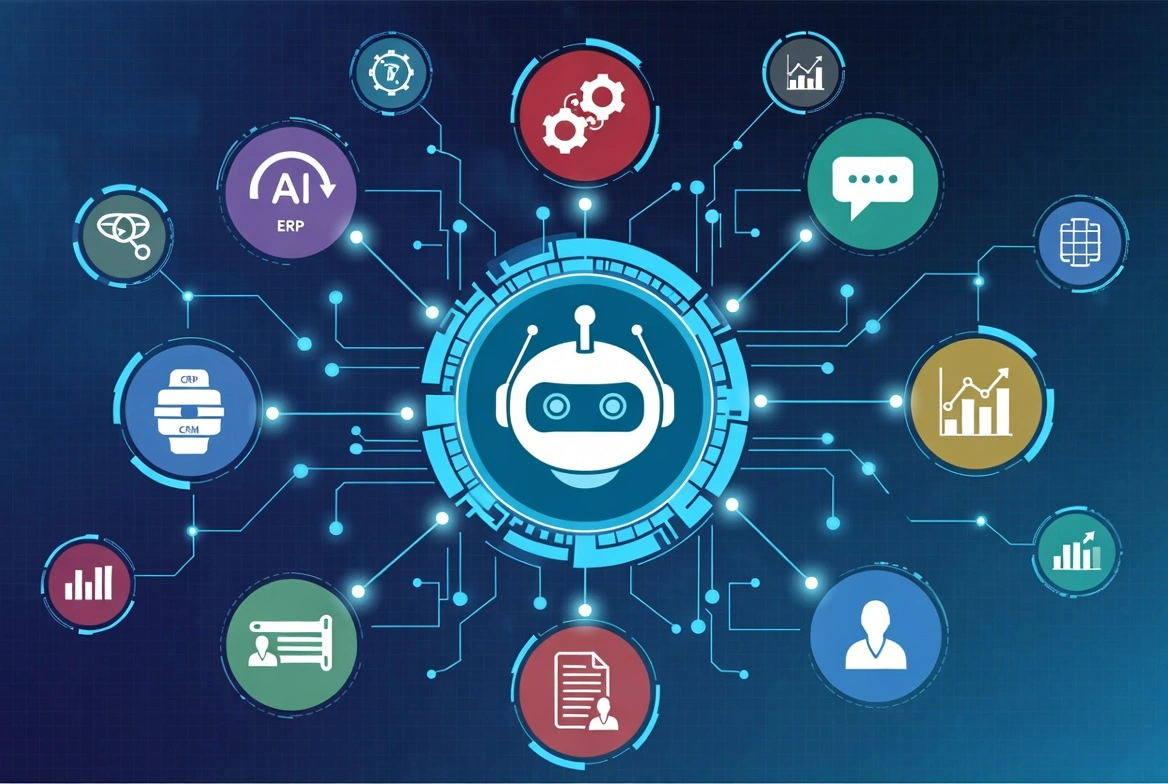
One of the most overlooked ROI factors is the chatbot's role as a system integrator. Modern enterprises operate with dozens of disconnected software systems, and AI-powered chatbots increasingly act as intelligent business orchestration layers rather than simple support tools. Chatbots can serve as a unified interface that connects CRM platforms, inventory systems, shipping software, and customer support operations without requiring expensive integration projects. Consider an enterprise with separate systems for CRM, inventory management, shipping, and customer support. A well-designed chatbot can pull information from all these systems to provide customers with real-time order status, availability information, and support options — without building custom integrations between each system. This evolution toward connected, decision-capable AI systems is part of the broader shift toward agentic AI transforming modern business operations. The ROI here isn't just the cost savings from automated interactions, but the avoided cost and complexity of traditional system integration approaches.
Common ROI Measurement Mistakes
Mistake 1: Measuring Activity Instead of Outcomes
Tracking conversation volume, response time, and completion rates tells you the chatbot is working, not whether it's solving business problems. Focus on business metrics that would matter whether the chatbot existed or not.
Mistake 2: Ignoring Change Management Costs
Successful chatbot implementations require changes in customer behavior, employee workflows, and organizational processes. These change management costs are real and should be included in ROI calculations.
Mistake 3: Short-Term ROI Expectations
Chatbots are infrastructure investments that create long-term value. Expecting immediate positive ROI often leads to disappointment and premature abandonment of otherwise successful projects.
Mistake 4: Not Accounting for Maintenance and Evolution
Chatbots require ongoing training, content updates, and system maintenance. ROI calculations based on implementation costs alone miss significant ongoing expenses.
Building a Sustainable ROI Framework
Successful enterprise chatbot ROI measurement requires a framework that evolves with your business and the technology.
Start with clear business objectives tied to measurable outcomes. Establish baseline measurements before implementation. Track both direct benefits (cost savings, revenue increases) and indirect benefits (data insights, process improvements, risk reduction).
Most importantly, design your measurement framework to capture compound benefits over time. The most successful enterprise chatbots create value that extends far beyond their original purpose.

The Partnership Approach to Chatbot ROI
At Tizbi, we've learned that sustainable chatbot ROI requires more than good technology - it requires a partner who understands your business deeply enough to identify and measure the outcomes that matter.
This isn't about building chatbots faster or cheaper. It's about building chatbots that solve real business problems and deliver measurable value over time.
We start with discovery, not development. We measure outcomes, not outputs. And we build long-term relationships focused on your success, not our technology capabilities.
If you're evaluating enterprise chatbot opportunities and want to discuss ROI measurement approaches that go beyond implementation metrics, we'd welcome the conversation. Sometimes the most valuable discussion happens before any development begins.