Artificial Intelligence, or AI, is here to stay, and we must rethink the way we make decisions, manage everyday tasks and get things done. It's time to make our businesses AI-fueled, unless we are okay with the idea of falling behind in a race with our competitors.
What does AI have in store for us, and is it a game-changer for every industry, or just for specific ones? And moreover, what should we do today to make sure we're augmenting our enterprises with AI, not ruining them in a thoughtless rush after novelties? We at Tizbi have some thoughts upon the matter, and we'd like to share them with you.
Table of Contents
- What Is AI and Why Some People Believe It Has Raised More Problems Than Solved
- Human + Machine: Reimagining Work in the Age of AI
- AI Empowers Enterprises
- AI Types
- Frequently Asked Questions
- How Can Your Business Benefit from Adopting AI-Fueled Solutions
What is AI and why some people believe it has raised more problems than solved
Artificial Intelligence is an intelligence of "smart" machines that mimic a human way to perceive the world around them, to learn and to make decisions in order to achieve certain goals, i.e. it can "think for itself" in a manner.
A chat-bot, an advanced software that recommends you music and movies, a self-driving car to name a few - these are examples of AI in our daily life. So what is AI basically capable of? Here are some activities that AI agents can perform (some of them are only able to do one thing, others can do 2 and more):

- Move
- Manipulate with objects
- Learn
- Solve Problems
- Plan
- Process natural language
- Perceive the environment
- Create things
- Communicate with humans and other AI agents
Although it is believed that AI will relieve workers from routine tasks and bring up new perspectives for science, business and other areas, there are certain fears related to a surge-like AI development.
- Some believe that AI may dislodge humans from certain jobs, leading to a high unemployment rate and strikes.
- Some believe that AI may fail to perform some tasks, especially those that need creativity and thinking outside the box. It may cause tragedies, if these failures happen when AI is dealing with issues like health care, etc.
- Some believe that AI may outsmart its creators and turn humans into slaves
Of course, the latter sounds more like a sci-fi movie plot, but the question is: can an AI perform better or at least as good as humans, and if it can, then what are we going to do with people losing their jobs?
The fact is, AI alone can beat a human mind in some cases. Many of you remember a game of chess featuring grand-master Garry Kasparov vs Deep Blue smart computer. AI won that game, but later Kasparov trained collaborated human-and-AI teams, and these teams persistently won the games against AI agents operating by themselves.
This brings us to a so called "centaur concept": human mind and AI can achieve better results when collaborating for a shared goal. Keeping that in mind, entrepreneurs should rethink their business models and make sure there is a place for both human employees and AI in it, no matter what industry we're talking about.
Human + Machine: Reimagining Work in the Age of AI
by Paul Daugherty and H. James Wilson

In "Human + Machine: Reimagining Work in the Age of AI" by Paul Daugherty and H. James Wilson we ran into a perfect wording for the idea: "As humans and smart machines collaborate ever more closely, work processes become more fluid and adaptive, enabling companies to change them on the fly - or to completely reimagine them. AI is changing all the rules of how companies operate."
AI empowers enterprises
The foregoing brings us to a conclusion that AI is not something we should fear of, but something that can enrich our experience by bringing new tools and perspectives to the table. AI can widen our perception of the world around us, which includes our enterprises as well.
An area of AI is not limited to processing big data or automatizing mundane tasks. Sometimes our ways to manage a business become predictable and limited, just like Go game moves. AI can boost our performance and open up new possibilities you never thought of considering.
Eager to dig deeper? Learn more about AI types, and about the ways companies can benefit from them.
AI types
When talking about AI, many of us visualize it as a smart robot like R2D2 or Data, but AI can be related to a wide range of appliances and software, many of them not even embodied. These are some of the basic AI types.
- Robotic Automation of Manufacturing Goods
AI-driven manipulators can perform dull repetitive tasks without making mistakes, getting tired, or having their eyes swimming.
- Machine Learning
Machine learning, or deep learning, is an AI feature that allows the AI agent to educate itself completely on its own, without any input from the creators or other agents. Sometimes this feature is described as a machine mastering actions that were not implied in the original software.
The profit of machine learning lies in its unlimited speed and range. Humans can teach an AI agent only this fast, but the agent itself can learn at the speed of light.
- Machine Vision
Machine vision is a feature allowing AI agents to observe the environment and analyze the data they gather. It can refer to literal observing with a camera, or perceiving the space with radio waves or some kind of sensors.
The usage of this technology includes face recognition, handwriting recognition, diagnosing diseases, finding inappropriate (or to the contrary, most wanted) images in a million of samples.
- Natural Language Processing
Natural language processing, or NLP for short, is a process of understanding human speech or written texts with an AI agent. It is useful for automated translation or finding certain words (e.g. words like 'discount' or 'sale' in an email's subject line are a spam alert for spam filters). Also this technology allows to create smart assistants like Siri or Alexa, as well as chat bots.
- Autonomous Embodied Robots
Autonomous embodied robots like Sophia or an AI-driven vacuum cleaner Roomba. There are also robots exploring martian grounds or sea depths, going far beyond a human explorer can reach. There are enterprises constructing robots to be companions and assistants for people with special needs.
Frequently Asked Questions
What is artificial intelligence, in simple business terms? AI refers to systems that mimic human perception, learning, and decision-making to accomplish specific goals - recognizing patterns, processing language, or making predictions faster and at greater scale than manual methods allow. It's a tool for extending human capability, not a replacement for human judgment.
Will AI replace human employees? Not in most cases - the strongest results come from combining human judgment with AI's speed and pattern-recognition, not from removing people entirely. Historical examples, like humans paired with chess engines outperforming either alone, show that human + machine collaboration consistently beats either working in isolation.
What's the "centaur" concept in AI adoption? The centaur concept describes a business model where employees and AI systems work side by side, each handling what they do best. Instead of full automation, work processes stay fluid - humans provide judgment and context, while AI handles data-heavy or repetitive tasks, and companies adapt the mix as needs change.
What are the main types of AI businesses use today? Common categories include robotic process automation, machine learning (systems that improve from data over time), machine vision (analyzing images or video), and natural language processing (understanding text and speech). Most business AI adoption combines two or more of these types rather than relying on just one.
How should a business decide where to start with AI? Start with a specific business problem, not the technology itself - AI adopted for its own sake rarely delivers ROI. Identify a process that's slow, error-prone, or data-heavy (decision support, customer experience, operational analysis), then evaluate whether AI meaningfully improves it before committing resources.
Is AI adoption realistic for a small or midsize business, not just large enterprises? Yes - AI tools have become more accessible and don't require enterprise-scale budgets to implement. The key is scoping adoption to a well-defined problem and building from there, rather than attempting an all-at-once transformation that outpaces the business's readiness or resources.
How can your business benefit from adopting AI-fueled solutions
One of the problems with leveraging AI to augment our enterprises is our perception of AI-based technologies like a thing-in-itself.
In order to resolve this dilemma, businesses should shift from technology itself to solving specific issues they face. And oftentimes it means that instead of having a robot mimicking human operational patterns we have to rethink the whole decision-making algorithm and combine the strengths of both humans and machines to increase efficiency of the system.
As Mike Rollings, a Gartner research vice president, puts it, "there is tremendous opportunity for enterprises to use AI now to reinvent business by cultivating intelligence." Tizbi strives to deliver custom-tailored AI solutions to enhance enterprises.
Be it an IT company, eCommerce or a manufacturing company, we do our best to help them reconsider their business model and get a leg-up in their race with competitors.
We are passionate about harnessing AI to serve the daily needs of entrepreneurs: to process big data, to help stakeholders make decisions, to improve customer experience by analyzing activity records, etc.
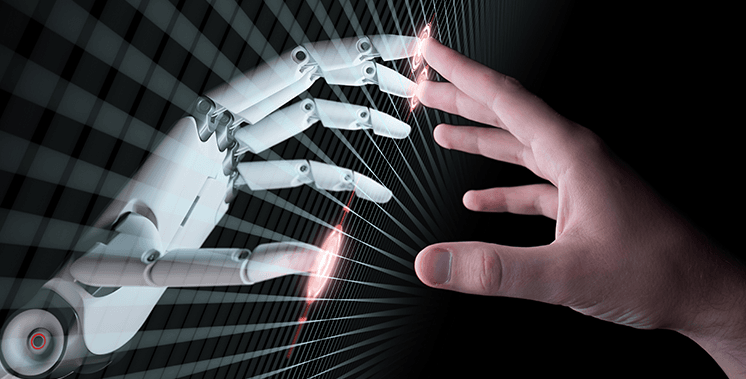
Isn't it fascinating to be not an observer, but a pioneer in adopting AI-related solutions for the benefit of the business and the community? We are super excited to be on the ride, and we're definitely enjoying it.
In a few years AI is going to be a must-have technology for most of the companies. Those who are already aware of it are one step forward, those who neglect the trend may find themselves trailing behind in a blink of an eye.
The question is, which side are you on?
If this article has aroused questions in your mind, or you are considering a possibility to explore what AI has for you at the moment, please know that Tizbi is around to help you.